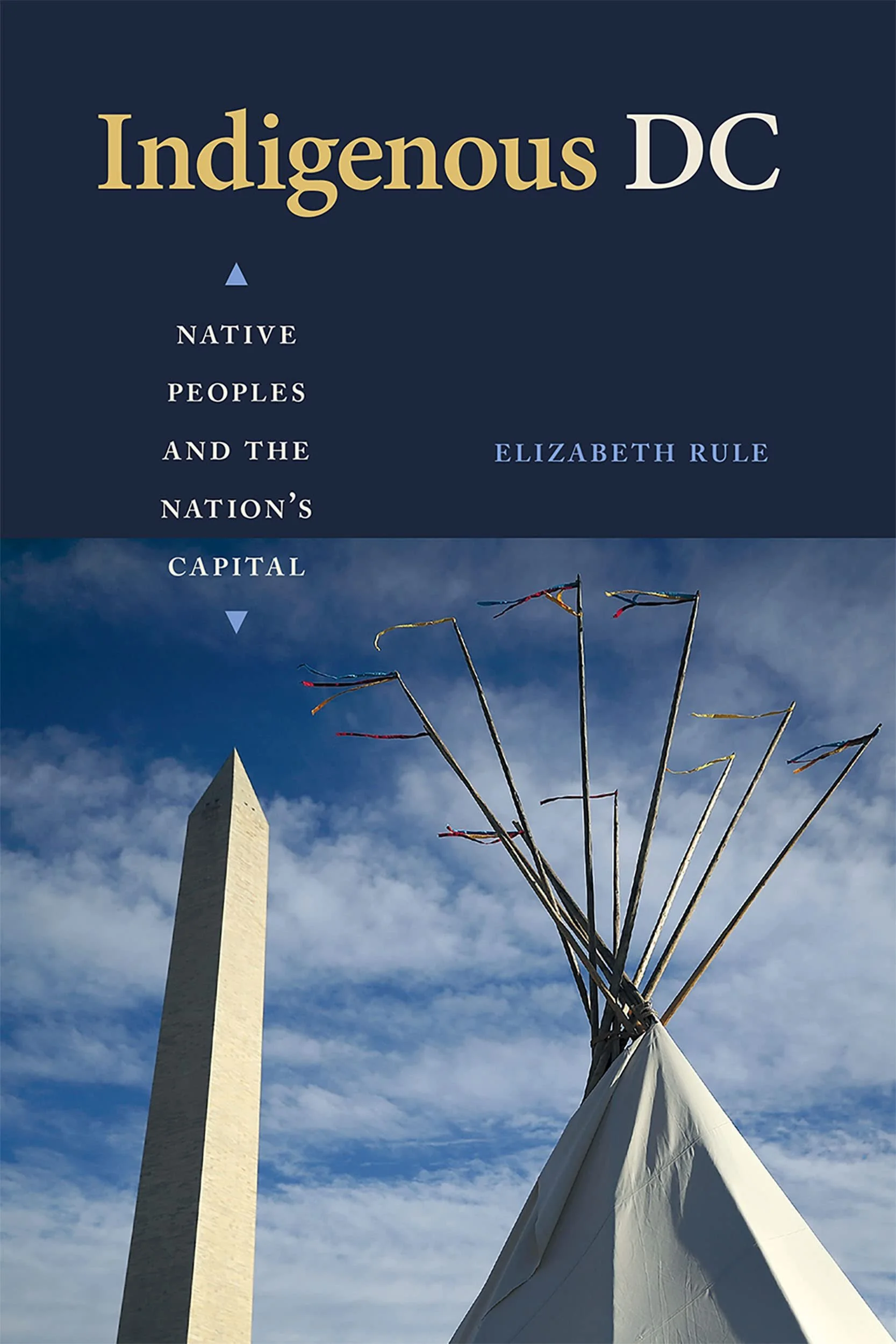
Indigenous DC: Native Peoples and the Nation’s Capital
Georgetown University Press, 2023
The first and fullest account of the suppressed history and continuing presence of Native Americans in Washington, DC
Washington, DC, is Indian land, but Indigenous peoples are often left out of the national narrative of the United States and erased in the capital city. To redress this myth of invisibility, Indigenous DC shines a light upon the oft-overlooked contributions of tribal leaders and politicians, artists and activists to the rich history of the District of Columbia, and their imprint—at times memorialized in physical representations, and at other times living on only through oral history—upon this place.
Inspired by author Elizabeth Rule’s award-winning public history mobile app and decolonial mapping project Guide to Indigenous DC, this book brings together the original inhabitants who call the District their traditional territory, the diverse Indigenous diaspora who has made community here, and the land itself in a narrative arc that makes clear that all land is Native land. The acknowledgment that DC is an Indigenous space inserts the Indigenous perspective into the national narrative and opens the door for future possibilities of Indigenous empowerment and sovereignty.
This important book is a valuable and informational resource on both Washington, DC, regional history and Native American history.
Seals, Selfies, and the Settler State: Indigenous Motherhood and Gendered Violence in Canada
American Quarterly 70.4 (2018)
From residential schools and sterilizations to assimilation-driven adoption and foster care abuses, settler colonialism targets Indigenous women in their roles as the reproducers of Indigenous cultures and nations, deeming them unfit and meeting them with violence. Such policies, both historical and contemporary, fuel and inform ongoing attacks on Indigenous motherhood. In this essay, I analyze the brutality leveled against famed Inuk throat singer Tanya Tagaq by settler environmentalists in 2014 after she posted online a photograph of her infant daughter next to a dead seal in solidarity with the pro–seal hunt Indigenous activist "Sealfie" campaign, as a primary example of this violence. I argue that the attacks on Tagaq in her positions as an Indigenous mother, activist, and celebrity showcase an unbroken onslaught of gendered violence coordinated by the settler states and its agents and serving assimilationist efforts through the current moment. I conclude with a discussion of how a focus on attacks on Indigenous motherhood, an understudied aspect of gendered violence against Indigenous women, can provide new insights into the Missing and Murdered Indigenous Women tragedy and Canadian state efforts to redress it.

The Chickasaw Press: A Source of Power and Pride
American Indian Culture and Research Journal 42.3 (2018)
Established in 2006, the Chickasaw Press is the first tribally-owned and operated publishing house in the United States. This article recounts the history of this innovative Indigenous enterprise, explores its decolonized practices and publications, and connects the Press to national initiatives for American Indian cultural revitalization. In doing so, I reveal how the Press serves as an active agent in the movement for Indigenous cultural and intellectual sovereignty and showcase how this outlet brings together traditional knowledge and cutting-edge technologies to decenter colonial narratives about the Chickasaw people and, thus, reinstate Chickasaw tribal knowledge and perspectives.